Key Takeaways
- Casement windows ventilate best for raw airflow: hinged at the side and swinging fully open, they catch Perth’s afternoon sea breeze and scoop it indoors, making them the strongest choice for cross-ventilation in living areas and bedrooms.
- Awning windows ventilate best in the rain: top-hinged so the open sash forms a small canopy, they let you leave the window cracked through a winter shower or a summer storm without water getting in.
- Sliding windows ventilate well over wide spans: only half the opening is ever clear at once, but a large slider gives you a big, low-fuss airflow area that suits hallways, bedrooms and tight reveals.
- Tilt and turn windows are the all-rounder: tilt inward at the top for secure trickle ventilation, or swing the whole sash in for a fully clear opening.
- Window style controls how air moves; double glazing controls comfort. Because uPVC is roughly 1,000 times less conductive than aluminium, a double-glazed uPVC frame lets you open up for a breeze on mild days and seal tight for thermal performance on extreme ones where you don’t trade one for the other.
- The right answer is usually a mix of styles across the home, planned room by room around how Perth’s breeze actually moves through your block.
Anyone who has lived through a Perth summer knows the rhythm: still, baking mornings, then the Fremantle Doctor rolling in off the coast in the early afternoon to drop the temperature by several degrees. Whether your home can actually use that sea breeze comes down to one detail most people never think about until renovation time the style of window you fit, and how it opens. Two homes on the same street, with identical orientation, can feel completely different inside because one was glazed with windows that catch the breeze and one was not.
This guide compares the four window styles WA homeowners ask about most for ventilation: awning, casement, sliding, and tilt-and-turn, and explains which ventilates best and why. It is a buyer’s comparison, not a product brochure, so where a style suits you we link to the dedicated page. The short version: there is no single “best” window for airflow; there is a best window for each room, each wall, and the way the breeze hits your block.
How a window’s design decides how much air it moves
Before comparing styles, it helps to understand what actually governs ventilation. Three things matter: how much of the opening is clear when the window is open, the direction the open sash throws air, and whether the design lets you ventilate safely in weather or when you are out.
A “fixed” picture window moves no air at all. Everything else sits on a spectrum. Windows hinged on a side or top edge swing the whole sash out of the way, so the entire opening becomes clear airflow and the angled sash can act like a scoop or a sail, redirecting a breeze that is travelling along the wall straight into the room. Windows that slide, by contrast, can only ever expose half their width, because one panel parks behind the other. That is the core trade-off behind every comparison below.
The second factor is cross-ventilation. Air needs an inlet and an outlet to actually flow rather than sit. The best-ventilated Perth homes pair a window on the breeze-facing wall (usually south-west, facing the coast) with an opening on the leeward side, so the sea breeze has a path through the living zone. The style you choose on each wall changes how strong that through-draught feels.
Casement windows: the strongest natural ventilator
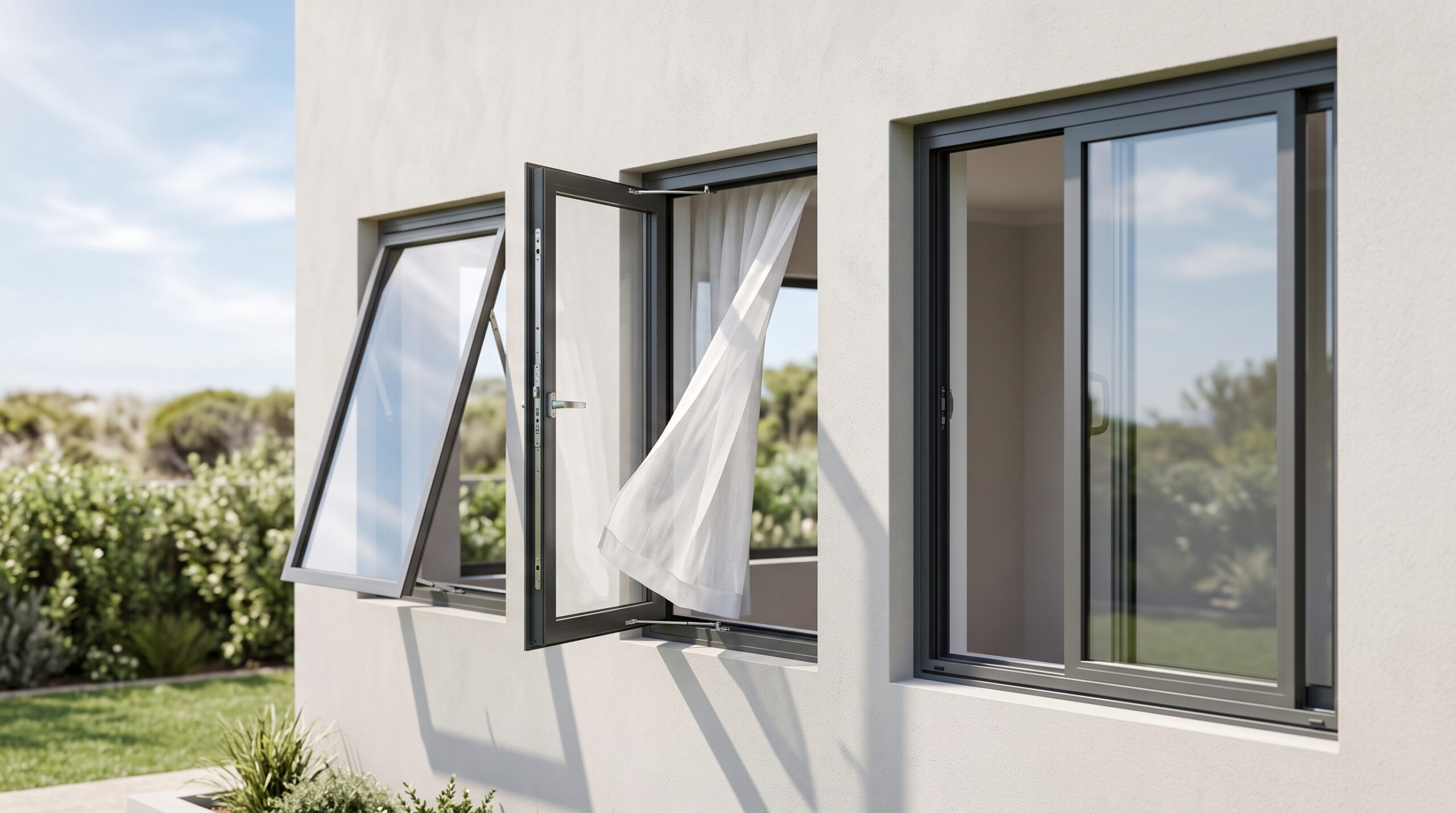
Casement windows are hinged on one side and crank outward like a door. When fully open, the entire sash swings clear, so 100% of the opening becomes usable airflow no overlap, no obstruction. This is why they consistently top every “best window for ventilation” list, and why they are the style to reach for when raw breeze is the priority.
The real advantage is directional. Because the open sash sticks out at an angle from the wall, a casement acts like a sail on a boat. A breeze travelling parallel to your wall which is exactly how the afternoon sea breeze often arrives hits the angled sash and gets funnelled inside. Even a window opened just a few centimetres can scoop a surprising amount of air this way. No other common style catches a glancing breeze as effectively.
Canon’s double-glazed casement windows are available as outward-opening single or double-leaf units, or inward-opening where external space is tight, and use a 4-point double locking mechanism with a fully internally beaded frame so that maximum airflow when open never means a compromise on security when closed.
Best rooms for casement windows
Living rooms, dining areas and main bedrooms anywhere you want a strong, room-filling draught and an unobstructed view. They are ideal on a south-west-facing wall to capture the Doctor, and they pair beautifully across a living zone with an opening on the far wall for true cross-ventilation.
The one watch-out
Because the sash swings outward, casements need to be closed in driving rain, and the open sash projects into outdoor space so they are not ideal directly over a walkway, paved alfresco edge or anywhere people pass close to the wall. That is exactly the gap the awning style fills.
Awning windows: the best ventilator for Perth’s wet season
Awning windows are hinged at the top and crank outward from the bottom, so the open sash forms a small sloping canopy an awning over the gap. That geometry is the whole point: rain runs off the angled glass and away from the opening, so you can leave an awning window cracked for fresh air right through a winter downpour or a summer storm without water coming in.
For Perth, where the wet comes in concentrated bursts between May and September, this matters more than the brochures suggest. It is the difference between a stuffy, closed-up house every time it rains and a home that keeps breathing year-round. Awnings also sit happily high on a wall, above benches and behind sinks, where you want light and a steady trickle of air but not a full-height opening.
Canon’s double-glazed awning windows use a top-hinged design built specifically to deliver ventilation in wet conditions, with a 28mm insulated glass unit, a 4-point double locking mechanism and double-sided EPDM gasket sealing that shuts out water and air leakage when closed.
Best rooms for awning windows
Bathrooms, ensuites, laundries and over kitchen sinks: moisture-heavy rooms that need constant gentle airflow to fight condensation and mould. High clerestory positions above doors or other windows. And any wall facing prevailing weather where you still want the option to ventilate when it is raining.
How awnings compare on raw airflow
An awning opens to a smaller angle than a casement swings, so on a still day a casement of the same size will move more air. The awning trades a little peak airflow for the ability to ventilate in any weather a trade that is well worth making in the rooms above.
Sliding windows: easy airflow across a wide opening
Sliding windows run on horizontal tracks, with one panel gliding behind the other. The limitation for ventilation is built in: because one sash always sits in front of the other, you can only ever open half the total width at once. A casement of identical size will out-ventilate a slider on a still day.
But sliders have practical strengths that keep them popular. They never project into indoor or outdoor space, so they suit walkways, alfresco edges and narrow side-of-house reveals where a swinging sash would be in the way. They are simple, robust and easy to operate with one hand. And because they are economical to make wide, a large slider gives you a big airflow opening cheaply — half of a very wide window is still a lot of air. On a breezy Perth afternoon, a generous slider on the windward wall and another on the leeward wall sets up perfectly good cross-flow.
Canon’s double-glazed sliding windows bring the same uPVC frame and sealed-unit glazing to a low-profile, space-saving format, which makes them a sensible default for bedrooms, hallways and any opening where a projecting sash is a nuisance.
Best rooms for sliding windows
Bedrooms, hallways, rumpus rooms and any wall along a path, patio or boundary where the sash must stay flush. They are also a comfortable, familiar choice for homeowners replacing existing aluminium sliders who want the same operation with far better thermal performance.
Tilt and turn windows: two ventilation modes in one sash
Tilt and turn windows are the European all-rounder, and they solve the ventilation-versus-security tension better than any single-action style. One handle position tilts the top of the sash inward a few centimetres for secure trickle ventilation air moves, but the gap is too small and the geometry too awkward for anyone to climb through, so you can leave it tilted overnight or while you are out. Turn the handle further and the entire sash swings inward like a door for a full, unobstructed opening and easy cleaning from inside.
For a security-conscious household that still wants night-time airflow in summer, that dual action is hard to beat. If this sounds like the answer for your bedrooms, the dedicated tilt and turn windows page covers operation and pricing in detail. The main trade-offs are that the inward swing needs clear space in front of the window, and the multi-point hardware makes them a premium option.
Side-by-side: which window ventilates best?
Pulling the four styles together against the things that actually matter for Perth airflow:
- Maximum airflow on a still day: Casement first (full sash swings clear and scoops side breezes), tilt and turn a close second in turn mode, awning third, sliding last (only half open at once).
- Catching a glancing side breeze: Casement is in a class of its own the angled open sash funnels parallel air indoors. Awning helps a little; sliding not at all.
- Ventilating in the rain: Awning is the clear winner; tilt-and-turn in tilt mode is reasonable; casement and sliding need to be closed in driving rain.
- Secure ventilation while out or asleep: Tilt-and-turn (tilt mode) leads, with awnings high on a wall a good second; casements and sliders rely on locking hardware and restrictors rather than geometry.
- Flush fit along a path or alfresco: Sliding wins outright; tilt-and-turn (tilt mode) and awning are acceptable; an open casement projects outward.
- Best in wet rooms (bath, laundry, over sinks): Awning, every time.
For a whole-home renovation, the smart approach is to mix styles: casements where you want the strongest breeze, awnings in wet rooms and on weather walls, sliders where space is tight, and tilt and turn where security and airflow both matter. You can see the full range and how they fit together on the double-glazed windows in the Perth hub.
Why double glazing changes the ventilation conversation
Here is the point most comparisons miss. With ordinary single-glazed aluminium windows, ventilation and comfort are in constant tension: open the window for breeze and you also let heat pour in or out, because the aluminium frame conducts temperature straight through the wall. So people keep windows shut and run the air conditioner instead.
Double-glazed uPVC breaks that compromise. uPVC is roughly 1,000 times less conductive than aluminium, and the sealed double glazed unit argon-filled, toughened, in configurations such as 4-20-4 or 4-10-4 dramatically slows heat transfer. The practical result is that on mild Perth days you open up and let the sea breeze do the cooling for free, and on extreme days you seal tight and the frame holds your conditioned air inside rather than bleeding it away. You get the airflow when you want it and the thermal performance when you need it, instead of choosing one. Canon customers typically report cooling-cost reductions of around 20–35% across summer once their home is double-glazed.
It is also worth noting that good airflow and good sealing together are what beat condensation and mould the awning over the shower clears moisture-laden air while it is open, and the warm inner pane stops water forming on the glass when it is shut. If you are weighing up a switch, our guide to replacing single glazing with double glazing walks through the process.
Fly screens and insect protection by window style
Ventilation is only useful if you can keep the breeze and exclude the mosquitoes a real consideration through a Perth summer evening. Screening differs by style. Sliding windows take a simple, durable external sliding flyscreen, part of why they remain such an easy default. Awning and casement windows, because the sash swings outward, are fitted with an internal screen on the room side, so it stays put while the sash operates. Tilt and turn windows also use an internal screen that works with both actions. None of the four styles forces you to choose between airflow and bug protection but confirm the screen type for each opening when you get measured, because it affects how you operate the window day to day.
Security: ventilating without leaving the house open
A window you are afraid to leave open is not really ventilating your home. Two things provide security: the hardware that locks the window shut, and the geometry that lets you ventilate safely while it is open. Canon’s awning and casement windows both use a 4-point double locking mechanism with a fully internally beaded frame, so the locking points are protected and the closed window is genuinely difficult to force. The robust double-glazed unit itself adds resistance; it is far harder to break through than a single pane.
For ventilating while you sleep or while you are out, geometry does the rest of the work. An awning set high on the wall is awkward to reach and opens to a limited angle. A tilt-and-turn in tilt mode leaves only a small, high gap. Both let air move while staying effectively secure. This is where matching style to room pays off: put the secure-ventilation styles in bedrooms and on accessible ground-floor walls, and save the wide-open casements for where you actively want them open and supervised.
Matching window style to your Perth home, room by room
Pulling it all together into a practical plan:
- Living and dining zones: Casements on the breeze-facing wall to scoop the Doctor, paired with any opening style on the opposite wall to complete the cross-flow.
- Main and guest bedrooms: Tilt-and-turn for secure overnight airflow, or sliders where space is tight and a flush sash matters.
- Bathrooms, ensuites and laundries: Awnings rain-proof, condensation-clearing, happy set high on the wall.
- Kitchens: Awnings over the sink for steady ventilation that works in any weather; a casement elsewhere in the room if you want a stronger flush of air.
- Hallways and stairwells: A high awning or a slider to vent rising hot air and complete a whole-home stack effect.
None of this is rigid; your block’s orientation, your roofline and how exposed you are to the coast all shift the answer. That is exactly what a measure and quote is for: someone standing in the room, working out where the air comes from. Canon is an in-house manufacturer and installer, so the same team that assesses your home also makes the windows and fits them typically within a 6–8 week lead time rather than handing the job to subcontractors.
Comparing the Main Window Types for Airflow
When you line up the most common window types side by side, the main difference comes down to how the sash moves and how much of the opening clears. Casement and awning windows both open outward and swing the whole sash free, so they deliver excellent airflow and excellent ventilation through large openings, while double-glazed sliding windows expose only half their width at once but suit wide spans and tight reveals. Casement windows offer the strongest pull on a direct breeze because the angled sash redirects the prevailing breeze indoors, whereas awning windows hold a tight seal high on the wall and keep working in light rain. The right window selection mixes these styles across different rooms so each opening matches how air actually moves through Australian homes, from living spaces on the breeze-facing wall to wet areas that need steady extraction.
How Frame Material and Glazing Affect Performance
How well any window performs depends as much on the frame material and glazing options as on the style. A uPVC frame seals tightly through a multi-point locking mechanism and a compression seal, so the closed window keeps a tight seal that single-glazed aluminium cannot match. The double-glazed unit itself uses two panes separated by an argon gas fill, and on hot east-facing walls a low E coating cuts radiant solar heat before it reaches the room. Together, these key features lift thermal insulation and energy efficiency, which is where the real energy savings and lower running costs come from. Because uPVC frames carry temperature far more slowly than aluminium, energy-efficient double-glazed windows let you open up for maximum ventilation on mild days and seal tight against the heat on extreme ones, holding steady indoor temperatures without forcing you to choose between fresh air and comfort.
Matching Window Style to Room and Position
Placement decides how each window performs as much as the style does. Outward opening windows such as casement and awning units suit high wall positions above benches and behind sinks, where you want ample natural light and a trickle of air but not a full-height opening; their geometry also lets the sash remain open in light rain without water ingress. Sliders keep a flush profile along an alfresco area or walkway where a swinging sash would be in the way, and they take large openings economically. For passive cooling that works across Australian conditions, position the inlet on the wall facing the prevailing breeze and an outlet on the opposite side so air has a clear path through living spaces and bedrooms. Awning windows are the natural fit for wet areas, bathrooms and laundries, where a tight compression seal and rain-proof ventilation matter most, while casements scoop direct breezes into the rooms where you spend the day.
Light, Comfort and Everyday Living
Beyond airflow, the window types you choose shape how a room feels to live in. Large openings and slim uPVC sightlines flood living spaces with natural light, and bringing in ample natural light is one of the simplest ways to lift both comfort and curb appeal at the front of the house. The same double glazing that delivers thermal insulation also softens outside noise, so a quiet bedroom and a bright, breezy living room are not competing goals. With the right glazing options and frame material behind every opening, energy-efficient windows give you year-round comfort, real energy savings and a home that breathes when you want it to and seals tight when you need it to.
Reading Real-World Double Glazing Performance
It helps to judge double glazing performance the way you live with it rather than on a spec sheet alone. A casement set the sash evenly along its hinge so it seals flat when closed and swings clear when open, which is why these windows provide such a strong, even draught compared with a slider. Awning units give you easy access to fresh air from a high or hard-to-reach position, and matching external glazed doors uPVC sliding or French doors onto an alfresco — extend the same sealed-unit glazing and airflow logic to the way you move between inside and out. Across the range, the styles are complementary rather than competing.
Casement vs Awning, Settled
The casement vs awning windows question rarely has a single winner. Casements move the most air and catch a glancing breeze; awnings stay open in the rain and sit comfortably high on the wall. In most homes, the answer is both, placed room by room so each window provides exactly the kind of ventilation that spot needs.
Frequently asked questions
Which window style is best for ventilation?
Casement windows ventilate best for raw airflow. Because the sash swings fully clear of the opening and angles outward, the entire opening becomes usable airflow and the open sash scoops side breezes indoors. The one exception is wet weather, where awning windows are best because their top-hinged sash lets you ventilate in the rain without water getting in.
Are awning or casement windows better for airflow?
On a still day a casement of the same size moves more air, because it opens to a wider angle and catches glancing breezes that an awning cannot. Awning windows trade a little peak airflow for the ability to stay open in the rain and to sit high on a wall. The best homes use both casements in living areas, awnings in wet rooms and on weather-facing walls.
Do sliding windows give good ventilation?
Sliding windows ventilate reasonably well but never as strongly as a casement of the same size, because only half the window can be open at once one panel always sits behind the other. Their advantage is that the sash stays flush, so they suit walkways and tight reveals, and a wide slider still provides a large airflow opening economically.
What windows are best for Perth’s climate?
A mix suited to Perth’s hot-dry summers and concentrated winter rain: casements to capture the afternoon sea breeze in living areas, awnings for rain-proof ventilation in wet rooms, and sliders or tilt and turn where space and security dictate. Pairing any of these with double glazed uPVC frames lets you ventilate freely on mild days and seal tight against the heat on extreme ones.
Can I leave windows open when it rains?
With awning windows, yes. The top-hinged sash forms a small canopy over the opening, so rain runs off the glass and away from the gap, letting you ventilate through a shower. Casement and sliding windows generally need to be closed in driving rain, while a tilt and turn in tilt mode offers some rain-resistant ventilation.
Does double glazing reduce airflow or ventilation?
No. Double glazing changes the glass and frame, not how the window opens. A double-glazed casement, awning or slider ventilates exactly like its single-glazed equivalent. What double glazing adds is thermal performance when the window is shut, so you can open up for breeze on mild days and seal in comfort on hot or cold ones rather than choosing between the two.
How do I get good cross-ventilation in my home?
Cross-ventilation needs an inlet and an outlet on opposite or adjacent walls so air has a path through the room. In Perth, position an opening on the south-west, coast-facing wall to catch the afternoon sea breeze and a second opening on the opposite side to let it out. Casements on the inlet side are most effective because they funnel the breeze inward.
Which windows are best for bathrooms and kitchens?
Awning windows. They sit comfortably high on a wall above benches and sinks, provide constant gentle airflow to clear steam and cooking moisture, and most importantly let you keep ventilating when it rains, which is exactly when bathrooms and laundries need it most to fight condensation and mould.
Get the right window in every room
The best window for ventilation is not one style; it is the right style on each wall, chosen around how the breeze actually moves through your block. Casements to catch the Doctor, awnings to breathe through the rain, sliders where space is tight, tilt and turn where security and airflow both matter, and double-glazed uPVC frames throughout so opening up for breeze never costs you comfort when the windows are shut.
Canon designs, manufactures and installs every window in-house in Perth, with interest-free finance available and a warranty across frames, hardware and sealed units. The best place to start is a walk-through of your home with someone who can read the airflow room by room. Book a free measure and quote and get a plan built around the way your home actually breathes.